
Female Personal Trainer at Home: A Guide Before You Book
A practical guide for women thinking about a female personal trainer at home: how the session runs, the space and equipment you need, and what to check before you book. It includes package prices in Saudi Arabia, Egypt, Kuwait and Qatar.
 By Ahmed SobhyCo-Founder & CEO | Fitness Operations & Business DirectorPublished
In this article 18
- Why do many women choose a female trainer at home?
- How does a home session run?
- What space and equipment do you need?
- What should you check before you book?
- How much does a female personal trainer at home cost?
- Where are female home trainers available?
- A trainer at home, a ladies' gym or online training?
- How to prepare for the first session
- Privacy and safety: practical points
- How many sessions a week do you need?
- When do you not need a home trainer?
- Frequently asked questions
- Does training at home give the same results as the gym?
- Does the trainer bring the equipment?
- Can I train with my sister or a friend in the same session?
- I am a complete beginner and overweight. Should I start with a trainer?
- What if no female trainer is available in my area?
- The bottom line
A female personal trainer at home is a qualified fitness trainer who comes to your home at a fixed time, assesses your level, writes a plan that fits your goal and the space you have, and corrects your technique movement by movement. Many women choose one because it brings three things together: full privacy, no travel time and a workout designed for you, not for a group.
If personal training is a new idea for you, start with what a personal trainer does and who needs one, then come back here.
Why do many women choose a female trainer at home?
Competence has nothing to do with being a man or a woman, and the choice comes down to your comfort. Still, the same practical reasons recur among women who choose a ladies' personal trainer at home:
- Privacy: you train in the clothes you find comfortable, with nobody watching and no queue for a machine.
- Time: no drive, no traffic and no search for parking. The session starts and ends in your home, which makes a big difference if you have a job or children.
- Ease of conversation: some subjects are easier to explain to a woman, such as exercise after childbirth, training during your period or pain in the pelvic area.
- Starting without embarrassment: many beginners put off the gym because they do not know how the machines work. At home you learn the basics calmly.
- Commitment: a fixed appointment with someone who knocks on your door is harder to cancel than an intention to go to the gym.
For a general comparison of training at home and in a gym, see our guide to a personal trainer at home.
How does a home session run?
A home session has its own order, and usually goes like this:
- Before the first session: the trainer asks about your goal, your health history, any injury or recent birth, and the space and equipment you have.
- The first session: it includes an assessment of your movement, strength and endurance, and light exercises in which you get to know the basic movements. This step is described in your first personal training session.
- Warm-up: 5 to 10 minutes of light movement and loosening the joints.
- The main part: full-body resistance exercises with body weight, dumbbells and resistance bands, with spells of movement that raise your heart rate. The trainer stands beside you and corrects the position of your back, knees and shoulders on every repetition.
- Cool-down and stretching: a few minutes at the end of the session.
- Between sessions: a serious trainer leaves you something to do on your own, such as walking or a short workout, and records your numbers so the load can rise gradually.
Sessions usually last 45 to 60 minutes. Ask before you book, as it varies between trainers.
What space and equipment do you need?
Less than you expect:
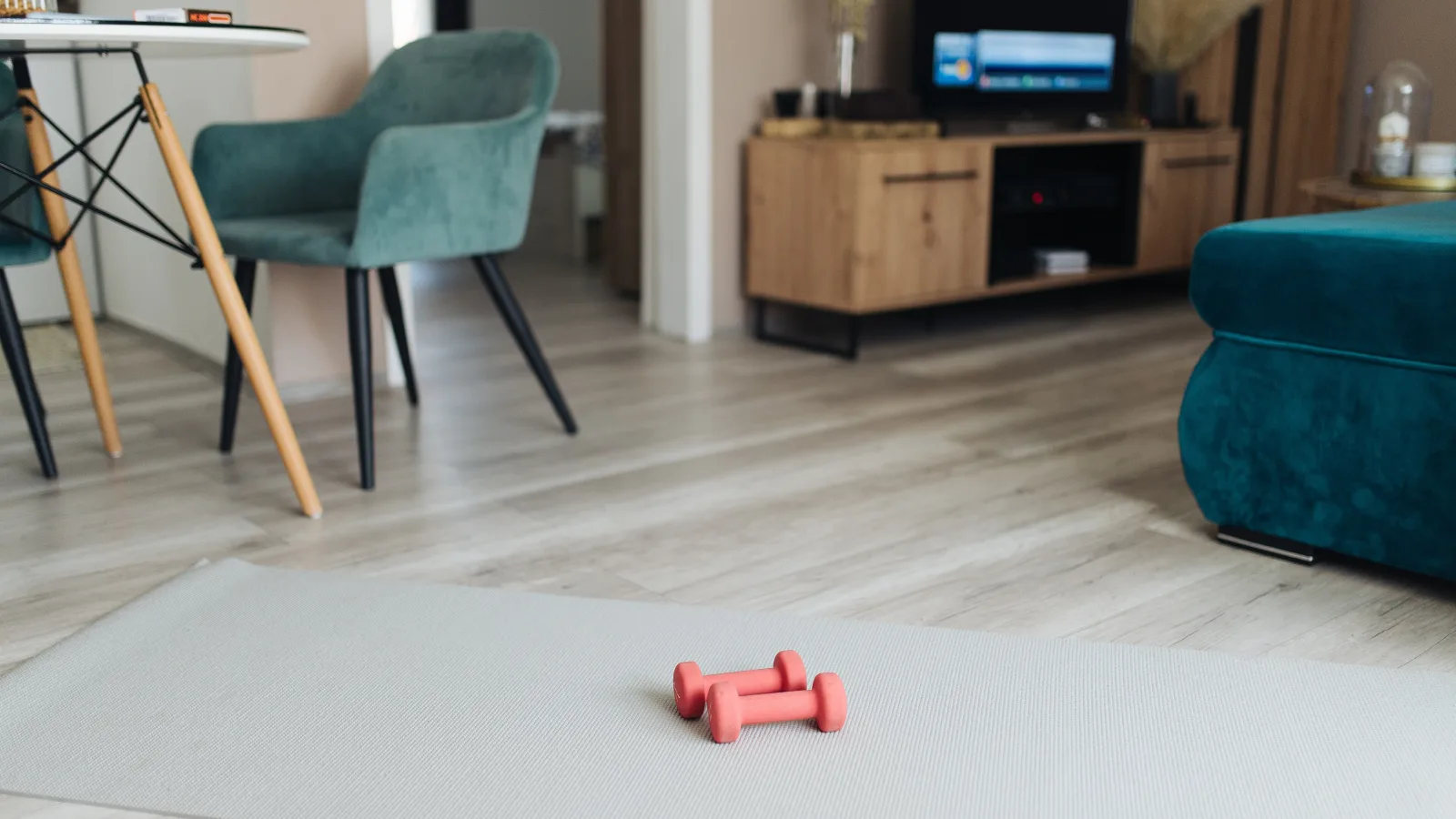
- Space: room for an exercise mat with space to stretch your arms in every direction. A corner of the living room or the bedroom is enough.
- Floor: a stable, non-slip surface, and an exercise mat for the movements you do on the floor.
- Equipment: light and medium dumbbells, resistance bands and perhaps a kettlebell. Many trainers bring their own equipment, so ask before you buy anything.
- Air and water: an air-conditioned or well-ventilated room, and a bottle of water next to you.
The one thing a home does not easily provide is heavy weights and machines. If your goal is advanced muscle building you will need a gym at a later stage, and an honest trainer will tell you so.
What should you check before you book?
The title "trainer" is not protected by law in most countries, so checking is your responsibility. Ask for four things:
- Qualification: a personal training certificate from a recognised body, or a university qualification in sports science.
- Experience with a case like yours: a complete beginner, after childbirth, a fat-loss goal, or pain in the knee or back. Ask her directly: have you trained cases like mine, and what did you do with them?
- Reviews from real clients that you can read.
- Clear terms: the session length, the cancellation and rescheduling policy, and whether the price includes a plan and follow-up between sessions.
Watch for two warning signs: a trainer who promises you a specific number in a specific time, and a trainer who prescribes supplements or a therapeutic diet, or diagnoses a pain. That is outside her job. The full list of questions is in how to choose a personal trainer.
How much does a female personal trainer at home cost?
These are Sporship home-training package prices in November 2026, for one client with one trainer in her home. Prices can change, and the first session includes an assessment:
| Country | One session | Monthly plan, 8 sessions | 3-month plan, 24 sessions |
|---|---|---|---|
| Saudi Arabia | SAR 250 | SAR 1,840 (230 per session) | SAR 5,160 (215 per session) |
| Qatar | QAR 250 | QAR 1,840 (230 per session) | QAR 5,160 (215 per session) |
| Kuwait | KWD 27 | KWD 168 (21 per session) | KWD 456 (19 per session) |
| Egypt | EGP 800 | EGP 4,800 (600 per session) | EGP 13,200 (550 per session) |
The more sessions in the package, the lower the cost per session. Some trainers on the platform set their own prices on their pages, so you may see different figures. To understand what pushes the price up or down, read our guide to personal trainer cost.
Where are female home trainers available?
Female trainers for home training are available on Sporship in four countries: Saudi Arabia, Egypt, Kuwait and Qatar.
- Saudi Arabia: the largest number of trainers is in Riyadh and Jeddah, along with Khobar, Dammam, Jubail, Mecca and Abha. Home-training requests are also taken in Medina, Tabuk and Taif.
- Egypt: Greater Cairo, with the largest number in New Cairo, then Heliopolis and Nasr City, Sheikh Zayed, Maadi, 6th of October, Madinaty and El Shorouk, Downtown and Mokattam.
- Kuwait: Kuwait City, Al Ahmadi, Hawally, Al Farwaniyah, Al Jahra and Mubarak Al-Kabeer.
- Qatar: Doha.
Availability differs from one area to another, and it is lower outside the big cities. If you cannot find a female trainer near you, online training is a practical alternative, especially if you already have training experience.
A trainer at home, a ladies' gym or online training?
All three work. The difference is what fits your life:
- A female trainer at home: the most privacy and the least wasted time, and every minute of the session is yours alone. The cost per session is higher because it covers the trainer's travel time.
- A ladies' gym: more machines and weights, and an atmosphere that encourages some women. It needs travel time, and if you want a private trainer inside it, her fee is added to the membership.
- Online training: lower cost and flexibility over time and place, but correcting technique through a camera is harder. It suits a woman with training experience more than a complete beginner.
Many women combine two options: home sessions in the first months to learn technique and build the habit, then a move to a gym or to online follow-up at a lower cost.
How to prepare for the first session
- Get the space ready before the appointment: move the small table and any rug that slides, and turn on the air conditioning.
- Wear comfortable clothes and stable trainers, and do not train barefoot on a slippery floor.
- Eat a light meal well before the session, and drink water.
- Write your goal in one sentence, along with any pain, injury or medicine you take, so you can tell the trainer from the start.
- Arrange for someone to look after small children during the session if you can, so you are not interrupted every five minutes.
Privacy and safety: practical points
- Book through a platform that shows the trainer's page, qualification and reviews, not through an unknown phone number.
- Agree the time and address in writing, and tell the household when the session is.
- No filming during the session without your permission. You have the right to refuse to have your workout filmed or posted.
- Your health information and measurements belong to you alone. A professional trainer does not talk about one client in front of another.
- If you do not feel comfortable after the first session, change trainer. Comfort is a condition for keeping going, not a luxury.
How many sessions a week do you need?
The World Health Organization recommends that adults do 150 to 300 minutes of moderate-intensity activity a week, with muscle-strengthening exercise on two or more days. In practice most clients start with two sessions a week with the trainer, which is what the monthly plan of 8 sessions covers, and fill the rest of the week with walking.
When do you not need a home trainer?
Honestly, not everyone needs one. You can do without if you have trained regularly for years, have mastered the basic movements and are still progressing, or if your goal is general activity and a sport you enjoy, such as brisk walking, is enough. On a limited budget, book a few sessions to learn correct technique and take a plan, then carry on alone and come back for a review from time to time.
Health notice: If you are pregnant, in the first months after childbirth, have a chronic condition such as diabetes, high blood pressure or heart disease, or have an injury that has not healed, consult a doctor before starting any training programme, and tell your trainer what the doctor said. A trainer does not diagnose or treat.
Frequently asked questions
Does training at home give the same results as the gym?
For a beginner, and for a woman whose goal is general fitness, fat loss and toning, yes, provided you train regularly and raise the load gradually. The difference shows only for someone who needs very heavy weights.
Does the trainer bring the equipment?
Many trainers bring simple equipment such as dumbbells and resistance bands. Ask when you book so you know what is missing.
Can I train with my sister or a friend in the same session?
The packages above are for one client. If you want to train with someone else, ask before you book, because the price and the plan are different.
I am a complete beginner and overweight. Should I start with a trainer?
Yes. A beginner benefits the most because she learns correct technique from day one. The trainer starts from your current level, not from anyone else's.
What if no female trainer is available in my area?
Try online training with a female trainer. It gives you the plan and the follow-up, and technique is corrected through the camera.
The bottom line
A female personal trainer at home suits a woman who wants privacy, saved time and a workout designed for her. You need no more than the space of a mat and simple equipment. Before you book, check the qualification, the experience with a case like yours and the clarity of the session length and price, and do not believe a promise of a number within a set time.
On Sporship you can browse female and male trainers by area and specialty, read client reviews and book sessions at home, in the gym or online.
Photo: Shixart1985, licensed under CC BY 2.0.
How this article was made: This article was prepared with the help of AI tools.