Exercise for Women Over 50: A Bone and Balance Plan
Exercise for women over 50 starts with balance, then strength, then walking and gentle impact work that supports your bones. Here is a three-stage plan for starting from zero, a sample week, and what to ask your doctor first.
 By Ahmed SobhyCo-Founder & CEO | Fitness Operations & Business Director
 Reviewed by Dr. Hagar AlyAmerican Board-Certified Clinical Pharmacist & Clinical Nutritionist
 Reviewed by Youssef HarounHead of Fitness & Sports PerformancePublished
In this article 12
- What changes after 50?
- Before you start from zero
- Stage 1: balance
- Stage 2: strength
- Stage 3: walking and impact exercise
- A sample week
- Frequently asked questions
- Is lifting weights safe after 50?
- Do I need a bone density scan before I start?
- Will exercise ease menopause symptoms?
- Should I start at home or with a trainer?
- The bottom line
Exercise for women over 50 works best when it starts with balance, then adds strength training, then walking and gentle impact exercise that supports your bones. If you are starting from zero, move up in stages and only progress when you feel confident with the movements. Check with your doctor first if you have not exercised for a while, have a health condition or have broken a bone.
This guide puts bones and balance first, explains the link to the menopause, and gives you a three-stage plan and a sample week. For a trainer who checks your form at home, read our guide to a female personal trainer at home.
What changes after 50?
The NHS says the menopause usually happens between 45 and 55, though it can happen earlier. The US National Institute on Aging explains that around the menopause women may lose bone mass quickly for several years, after which the loss slows but continues, and that osteoporosis affects about one in five women over 50.
The NHS osteoporosis page notes that it develops slowly, usually without obvious symptoms, and the first sign is often a broken bone after a minor fall. The National Institute on Aging adds that for people with weakened bones, a fall is more likely to cause a fracture. That is why balance comes first in this plan.
Among menopause symptoms, the NHS lists muscle aches, joint pains and weakening bones. Exercise does not treat the menopause, but it is one of the most useful things you can do for your muscles and bones through it.
Before you start from zero
- The NHS adult activity guidelines advise speaking to your GP first if you have not exercised for some time, or have medical conditions or concerns.
- The Royal Osteoporosis Society says to talk to your doctor or physiotherapist before any exercise if you have a history of many broken bones or spinal fractures, or are recovering from a broken bone.
- If you have been diagnosed with osteoporosis or have had a fracture, your doctor or physiotherapist sets the programme, and a trainer works within it.
Stage 1: balance
The Royal Osteoporosis Society says you should feel steady on your feet before building up strength and impact exercise, and its balance page recommends balance exercises on at least two days a week, building to every day if you can. These come from the NHS balance exercises; do them near a wall or a stable chair.
| Exercise | Amount | Easier | Harder |
|---|---|---|---|
| Sideways walking | 10 steps each way | Smaller steps | Walk from one side of the room to the other |
| Heel-to-toe walk | At least 5 steps | Fingertips on the wall | Move away from the wall |
| One-leg stand | 3 per leg, 5 to 10 seconds | Fingertips on the wall | Lighter touch on the wall |
| Step-up | Up to 5 per leg | Low step with a railing | Slower up and down |
Stage 2: strength
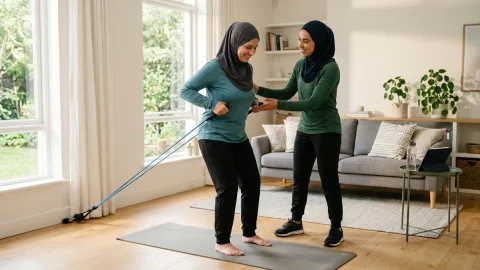
The society's strength exercise page recommends strength work on 2 to 3 days a week with a rest day in between, for 20 to 30 minutes covering legs, arms, back and stomach, building up to 3 sets of 8 to 12 repetitions. It suggests starting with body weight, then resistance bands, then weights, and says filled water bottles work too. Here is a starting point from the NHS strength exercises, with its own numbers:
| Exercise | Starting amount | Easier | Harder |
|---|---|---|---|
| Sit-to-stand | 5 slow reps | Use hands only to guide you | Add reps gradually |
| Mini squat | 5 reps | Shallower, holding the chair back | Deeper, within comfort |
| Calf raise | 5 reps | Holding the chair back | No support |
| Wall press-up | 3 sets of 5 to 10 | Stand closer to the wall | Stand slightly further away |
| Biceps curl with water bottles | 3 sets of 5 per arm | Seated | Light dumbbells |
Stage 3: walking and impact exercise
The society's impact exercise page explains that impact happens when you are on your feet and force travels through your bones each time your feet hit the ground:
- Low impact: one foot always stays on the ground, as in walking, marching and stair climbing. It can help reduce the loss of bone and muscle strength.
- Moderate impact: you push off and land with medium force, as in jogging, skipping and dancing. It can help improve bone strength.
Start with low impact and build up. The society says that if you do not have spinal fractures, you can work up to 50 moderate impacts on most days, spread through the day, and that high-impact exercise is not needed for bone strength. If you have had spinal fractures or many broken bones, stay with low impact. Alongside this, the World Health Organization recommends at least 150 minutes of moderate activity a week, such as brisk walking.
A sample week
| Day | What you do |
|---|---|
| Saturday | Strength exercises, then 5 minutes of balance |
| Sunday | Brisk walk |
| Monday | Balance exercises and an easy walk |
| Tuesday | Strength exercises, then 5 minutes of balance |
| Wednesday | Brisk walk, with impact moves once you reach stage 3 |
| Thursday | Balance exercises and an easy walk |
| Friday | Rest or a gentle walk |
When to move up a stage? The Royal Osteoporosis Society says you may be ready when you feel confident with the movements and techniques. There is no fixed date.
Frequently asked questions
Is lifting weights safe after 50?
The Royal Osteoporosis Society says most people with osteoporosis can exercise safely, and that how you lift matters more than how much. Start with a weight you can lift easily, and put it down if you feel strain in your back.
Do I need a bone density scan before I start?
That is your doctor's call. The NHS says your GP assesses your risk and may refer you for a bone density (DEXA) scan. Ask about it if you have risk factors or a past fracture.
Will exercise ease menopause symptoms?
The NHS says eating well, exercising and looking after your mental wellbeing can help with symptoms. Exercise is not hormone treatment, though, and any treatment for symptoms is a decision to make with your doctor.
Should I start at home or with a trainer?
Stages 1 and 2 suit home well. If you want someone to correct your form from day one, see how to choose a female personal trainer and what happens in your first session.
Health notice: a trainer does not diagnose or treat. After an osteoporosis diagnosis or a fracture, your doctor or physiotherapist sets the right programme. The Royal Osteoporosis Society advises stopping exercise if you feel sick, dizzy or lightheaded, severely short of breath, clammy or sweaty, have chest tightness or any pain, and calling for urgent help if you need it.
The bottom line
After 50, start with balance, then strength, then walking and gentle impact exercise, and move up when you feel confident rather than by a date. See your doctor first if you have a diagnosis, a past fracture or have not exercised for a while. With Sporship, a female trainer comes to your home, assesses you in the first session and builds a programme for your goal.
Photo: John Phelan, licensed under CC BY 4.0.
How this article was made: Drafted with the help of AI tools, then reviewed and edited by a Sporship specialist, using the sources linked in the article.